
School & institutional floor coatings
Work in an occupied school happens in the holidays or it does not happen. We scope to the calendar you actually have — February break, April break, the summer — and specify low-odour systems so the building is usable the moment the students are back.
The constraint is the calendar, not the floor.
A school corridor is an easy floor to specify and a hard one to schedule. The window is fixed months ahead, it does not move, and the building has to be open and odour-free on the first morning back. Most of what goes wrong on school work is a contractor who scoped the floor properly and the calendar optimistically. The second problem is odour. A standard epoxy in an occupied wing over a four-day break is a complaint waiting to happen, and there are low-odour systems specified for exactly this.
Where we are the right call
- Corridors, cafeterias, locker rooms, gyms and entry vestibules
- Kitchen and servery floors on a school catering operation
- Work that has to complete inside a fixed holiday window
- Buildings needing low-odour systems because part stays occupied
- Public bid work with prevailing wage and documentation requirements
Where we will tell you something else
- Gym floors where a sports surface, not a coating, is the right answer
- Asbestos-containing floor tile until abatement has been done by others
- Windows too short for the system the space actually needs
- Classrooms where sheet vinyl would serve better and cost less
- Any scope that would leave odour in an occupied wing on the first day back
What gets installed, and what it is rated for.
| Typical system | Quartz broadcast in wet and high-traffic areas; flake or solid-colour epoxy in corridors and storage |
|---|---|
| Build thickness | 1/8″ quartz in locker rooms and serveries; 20–30 mils in corridors |
| Surface preparation | Diamond grinding to CSP 2–4 with HEPA extraction throughout — a working requirement in an occupied building, not an upgrade |
| Odour | Low-odour and low-VOC systems specified where any part of the building stays occupied |
| Slip resistance | Graded by room — heavy in showers and locker rooms, moderate in serveries, lighter in corridors |
| Chemical resistance | Institutional cleaning chemistry, sanitiser, food acids in catering areas, de-icing brine at entries |
| Return to service | Foot traffic 10–14 hrs · full use and cleaning 24–48 hrs |
| Scheduling | Scoped to the actual holiday window, with the areas that will not fit named before the contract rather than after |
| Warranty | Written workmanship warranty, terms by system |
How we keep you running while we work.
Every commercial proposal we issue includes a phasing plan and the hours each zone is out of service. If we cannot make the window work, we will tell you at the walk-through rather than halfway through the install.
Scope to the calendar
We walk the building with facilities, confirm the window, and say plainly what fits in it and what does not.
Before the contractIsolate the wing
Containment and HEPA extraction so any occupied part of the building stays open and dust-free.
Occupied buildingsInstall to the window
Crews sized to finish inside the break rather than to stretch across two of them.
Inside the breakHand back before the bell
Walked with facilities and signed off with a day in hand, not on the morning.
A day in handA recent job in this sector.
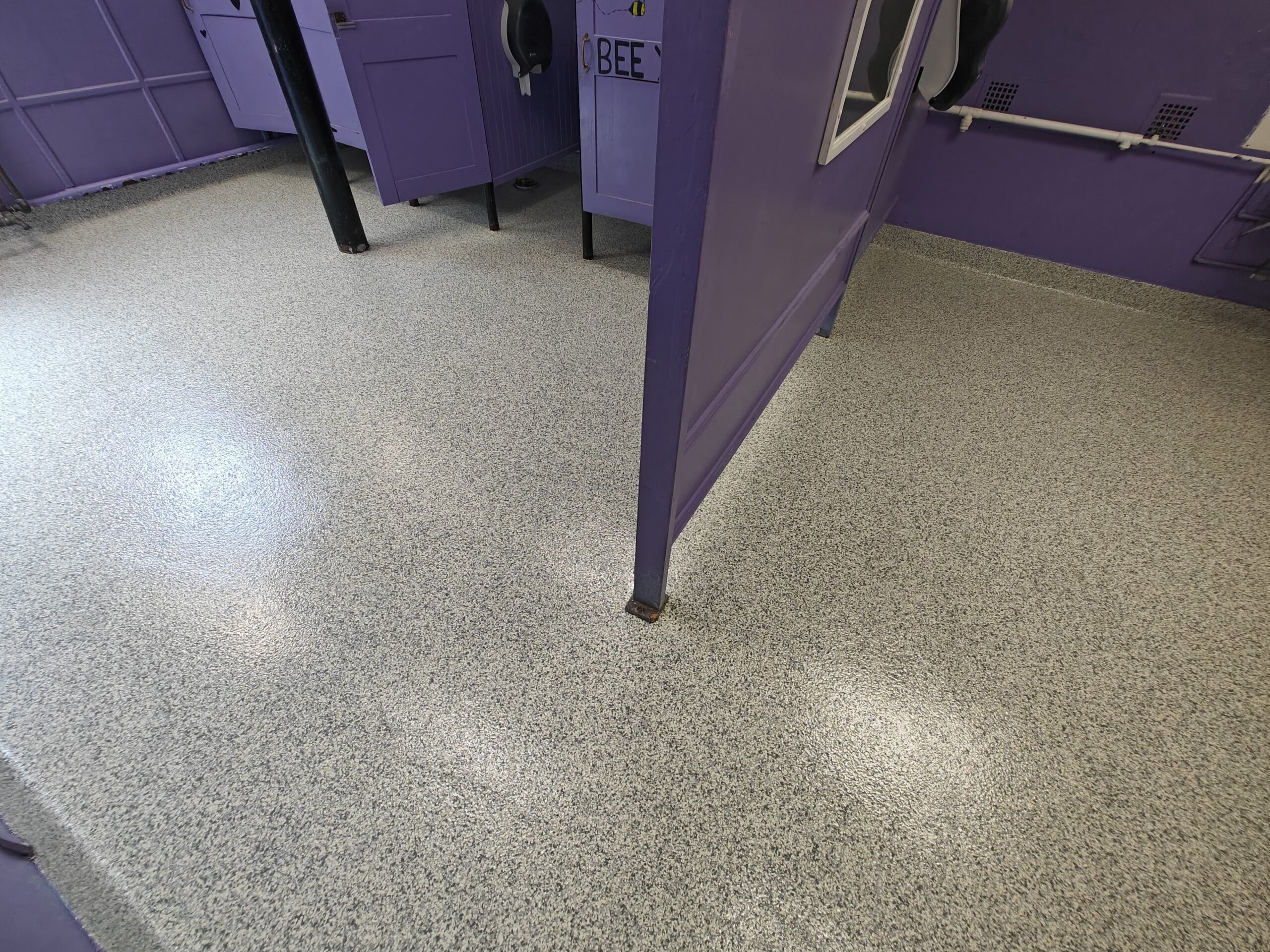
Public School Flake Flooring, South Berwick, ME
Removed the existing VCT flooring and installed a Full Broadcast Flake System throughout the school.
What facility managers ask us first.
Can you finish inside a one-week break?
Will the building smell when the students come back?
Do you work public bids?
What about the old tile in the corridors?
Walk the building with us.
An hour on site gets you a moisture reading, an honest assessment of the slab and the joints, a system recommendation, and a phasing plan that fits your operation. No obligation, and no pressure to decide on the spot.